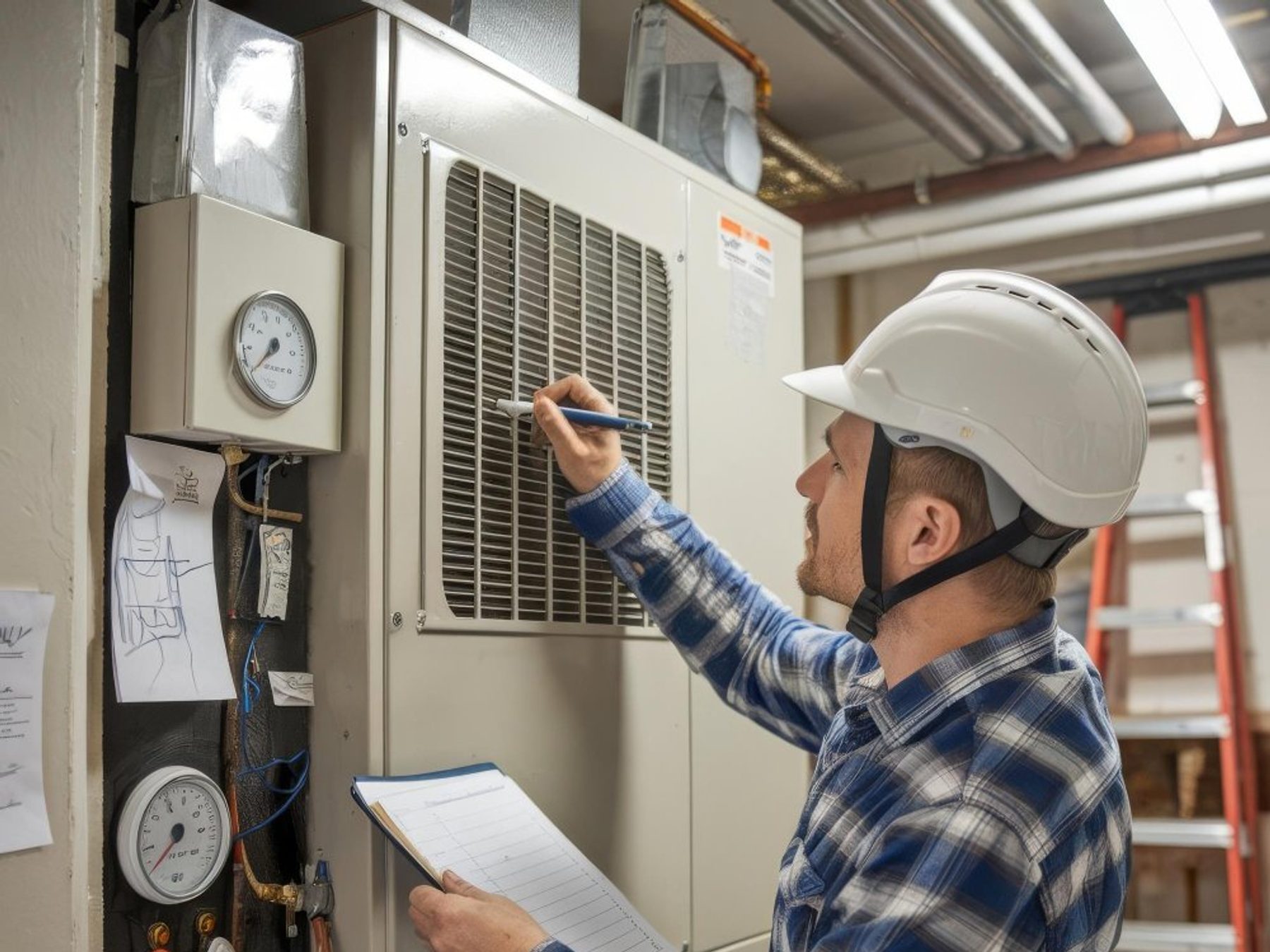
When the temperature climbs in the Central Valley, the part of your system that comes under the most pressure is the filter. It is also the cheapest, the only one you can change yourself, and the one most people leave too long.
Summer also puts more into the air than the other seasons do. Pollen, dust, mould spores, pet dander and smoke from wildfires all come in through the same path, and the filter is the only thing between them and your living room. Here is how to choose one that actually does its job.
What does the MERV number on a filter actually tell you?
MERV stands for Minimum Efficiency Reporting Value. It rates how well a filter captures particles of different sizes, and the scale runs from 1 to 20. A higher number means smaller particles are trapped, which also means a tighter filter and more resistance to airflow.
| MERV rating | Particles it traps | Typical use |
|---|---|---|
| 1 to 4 | Large particles such as dust, lint and hair | Minimal filtration, older or low efficiency systems |
| 5 to 8 | Mould spores, dust mites and pollen | Standard homes with a low allergy risk |
| 9 to 12 | Pet dander, exhaust fumes and fine dust | The right choice for most homes in the summer |
| 13 to 16 | Bacteria, smoke and microscopic particles | High efficiency systems, and homes with health concerns |
| 17 to 20 | Viruses and ultrafine particles | Hospitals, cleanrooms and specialist applications |
Which MERV rating should you buy for the summer?
For most homes around Stockton, Modesto and Sacramento, the answer is between MERV 8 and MERV 13.
- MERV 8 is the sensible starting point. It catches dust, lint and pollen at a price that does not hurt, and it lets enough air through for any normal residential system.
- MERV 11 to 13 is the better choice for a family with children, pets, or somebody in the house with allergies or asthma. It catches the smaller particles that carry pollen and dander.
- MERV 14 and above is where you need to be careful. Those filters are built for equipment that was designed to handle them. On a system that was not, the pressure drop makes the blower work harder, the energy use go up and the motor wear out sooner.
There is one more thing the MERV number will not tell you, which is the size. Get that right and the rating is only half of it.
The five filter types and who each one suits
Fiberglass filters, MERV 1 to 4
The cheapest option and the most common in older systems. They are disposable, easy to find and they catch the big stuff, which is dust and lint. They do not do much with pollen or fine particles, so a family with allergies will not be happy with them. If airflow is the priority in a hot climate, they are hard to beat on price.
Pleated filters, MERV 8 to 13
The best all round choice for a home. The pleats give them far more surface area, so they capture pollen, pet dander and dust mites while still allowing enough air through for a standard system. The trade off is that they need changing more often, usually every 30 to 90 days, and they cost more than a fiberglass filter.
Electrostatic filters, MERV 8 to 10
These use a static charge to pull particles out of the air. The washable versions can be rinsed and reused, which suits a household that dislikes throwing money away every two months. The catch is that they only work if they are washed properly, and a filter that is rinsed badly and left damp will not capture anything. Check the manufacturer's cleaning instructions.
Activated carbon filters
Carbon media absorbs gases and odours rather than particles, which is what makes them useful during wildfire smoke and for a musty house. They are normally used in combination with a particulate filter, not on their own, because on their own they do very little to the dust in the air.
HEPA filters, MERV 17 to 20
HEPA filters capture particles down to 0.3 microns, which is the standard used in hospitals and cleanrooms. They are the most effective filters made for a building. They are also the most restrictive, and most residential systems were never designed to move air through one. Fitting a HEPA filter to a system that was not designed for it can shorten the life of the fan motor and raise your energy use.
How often should you change filters in the summer?
| Filter type | Check it | Change or clean it |
|---|---|---|
| Standard pleated, MERV 8 to 11 | Every month | Every 60 to 90 days |
| High efficiency pleated, MERV 11 to 13 | Every month | Every 30 to 60 days |
| Home with pets or allergy sufferers | Every month | Every 30 to 60 days |
| Washable electrostatic | Every month | Clean once a month |
| HEPA or carbon | Follow the manufacturer | Follow the manufacturer |
Set a phone reminder for the first of each month. It takes a minute to look at the filter and it is the cheapest maintenance in the house.
Signs your filter needs replacing now
- You are getting warm air even though the system is running.
- Your energy bill has jumped for no obvious reason.
- Your indoor air smells musty or dusty when the system starts.
- You can see dust building up around the vents and registers.
- Allergy symptoms get worse while you are indoors.
- The system is short cycling, or the coil is icing over.
Getting the size right
Filters come in a lot of sizes, and the number is printed on the frame of the old one. Measure the filter cabinet as well, because manufacturers change the frame without changing the printed size. Common sizes include 16 by 20 by 1, 20 by 25 by 4 and 16 by 25 by 1. A filter that is too small leaves a gap that lets unfiltered air straight through. A filter that is too large will not seat properly in the rack, and a filter that is too thick for a one inch slot will not slide in at all.
What a summer service should include
A proper summer service is more than a filter change. Ours includes the following.
- Inspect the filter housing and fit the correct replacement filter.
- Clean the blower components and the motor housing.
- Check and clean the evaporator and condenser coils.
- Calibrate the thermostat so it is calling for the right temperature.
- Test the airflow and inspect the ductwork for leaks.
A refrigerant charge is not a tune-up item. If the system is low on refrigerant it is because it is leaking, and that is a repair with a diagnosis and a price, not a line on a maintenance list.
When to stop and call a licensed technician
Changing a filter is a safe job. A few things that look like a filter problem are not.
- The filter housing is damaged, bent or rusted, so the filter will not seat properly and air is bypassing it.
- The system freezes up every time you run it, even with a brand new filter. That points to an airflow or refrigerant fault, not the filter.
- The system short cycles constantly and the house will not hold the temperature you set.
- You hear a rattling noise in the cabinet when the blower starts, which may be a loose filter rack or a failing blower.
- The blower is running but no air reaches the rooms, which means a closed damper, a disconnected duct or a failed motor.
Do not modify a filter cabinet, a damper or a duct to make a filter fit. If the right filter will not go in, the fix is in the equipment, and that is a licensed technician job. RB HVAC Inc. is based in Stockton, licensed in California under number 1094161, and we service homes across Stockton, Sacramento, Modesto and surrounding communities.