Most people only find out what a maintenance visit contains when one is booked, and by then they have no way of judging whether it was thorough. Here is our full list, in the order we work through it, with what the technician is actually looking for at each step and what happens if that step is skipped.
There are ten steps. Not ten things to glance at. Ten things to check properly, in this order, because the order makes each one easier to read.
The ten steps of a professional HVAC maintenance visit
1. The air filter
We check the filter fits the slot and has not been left in too long. A restricted filter is the most common reason a residential evaporator coil ices up in July, and it also raises static pressure, which makes the blower work harder.
2. The exterior condenser unit
We clear vegetation, check the clearance around the unit, clear debris packed into the fins, and look for bent fins and corrosion. A condenser with no airflow runs hot, the compressor works harder to compensate, and that is a common route to a failed compressor in August.
3. The evaporator and condenser coils
Two coils in two places. The evaporator coil sits inside the blower cabinet and collects dust and dust mites from the air passing over it. The condenser coil sits outside and collects cotton, dust and leaves. We clean the evaporator and comb the bent fins.
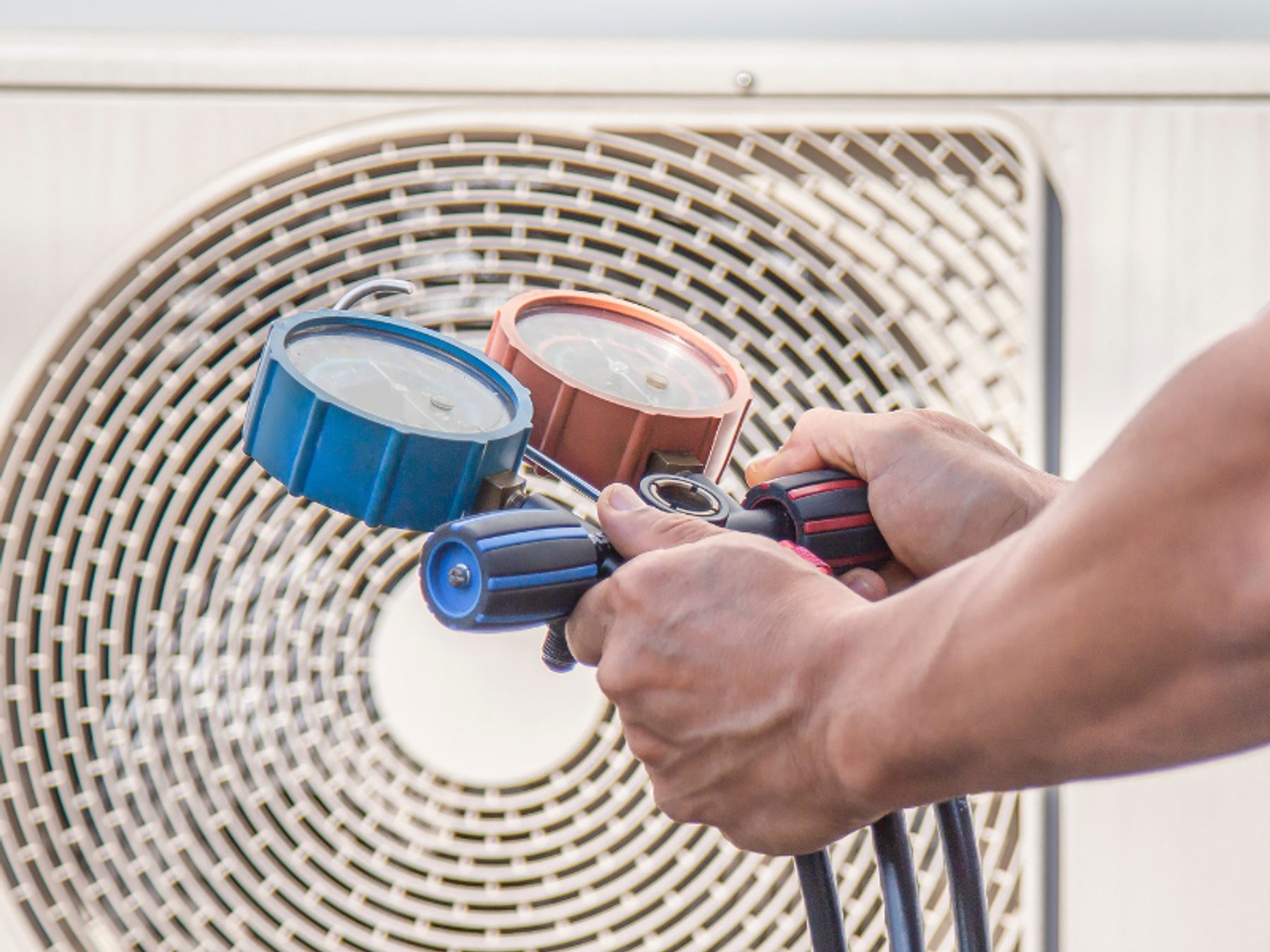
4. Refrigerant quantities
We check the temperature split across the lines, read superheat and subcooling on the gauges, and look for signs of a leak. A system low on refrigerant is almost always leaking somewhere, and topping it up without finding the leak resets the clock on a bigger problem later.
5. The electrical connections
We look at the disconnect switch, the contactor, the capacitors and the low voltage wiring, and check for corrosion, scorch marks and loose terminals. We also compare the amperage the blower draws against the nameplate. A corroded connection is a fire risk and a common cause of nuisance trips.
6. The ductwork and the vents
We look at supply and return ducts for disconnected or crushed flexible runs, gaps around registers and returns, and blocked returns. Our published duct loss figures put the air lost through leaks at up to 30% of heated or cooled air, and 20 to 30% of the cooled air.
7. The thermostat
We check that the batteries or power are good, that the mode is right, and that the system is not being asked to cool and heat at the same time. A thermostat that is not talking to the system produces short cycling.
8. The condensate drain pipes
We check the drain pan, the trap, the line and the float switch, and look for the algae and sludge that build up in a warm drain line over a season. If the drain backs up, water ends up in the pan and can overflow into the ceiling or the ductwork. In an attic that is serious.
9. Fan and blower performance
We listen for the bearing noise that says a blower wheel is about to fail, look at the wheel and the belt, and measure the blower amperage. We also check airflow across the evaporator and the static pressure the system runs at. Low airflow chills the coil until it ices.
10. The full professional inspection
This is the step that ties the other nine together. We run the system under load and watch everything at once, check the safety items including carbon monoxide and the heat exchanger on a gas furnace, and write down what we found and what we would do next.
What you can do yourself, and what needs a technician
Half of this list is useful to do between visits, and half needs gauges, meters and training.
| Step | Homeowner can do it | Technician only |
|---|---|---|
| Air filter | Yes, check monthly in summer | Yes |
| Outdoor unit clearance | Yes, clear the weeds | Yes, coil washing |
| Coil cleaning | No | Yes |
| Refrigerant measurement | No | Yes, measured properly |
| Electrical connections | Reset the breaker only | Yes, contacts and capacitors |
| Ductwork and vents | Look and report | Yes, sealing and camera checks |
| Thermostat | Yes, batteries and schedule | Yes, wiring |
| Condensate drain | Pour water down it in season | Yes, clearing a blocked line |
| Fan and blower | No | Yes |
| Full inspection | No | Yes |
And these are the homeowner jobs worth doing on a schedule rather than once.
- Check the filter monthly through the cooling season. If you cannot see light through it, it is too dirty. Replace it every one to three months, sooner if you have pets.
- Keep the outside of the condenser clear. Trim plants back about two feet and wash the fins gently from the top down, without forcing water into them.
- Pour a cup of water down the condensate drain line once a season. If it does not drain, it is blocked and needs a technician.
- Check your thermostat batteries twice a year. When the time changes, change them.
- Watch for the warning signs between visits. Water under the outdoor unit, a burning smell, a unit that runs constantly without cooling, and a bill that keeps climbing all mean something needs attention.
What skipping maintenance actually costs
Nothing, for a while, which is exactly the problem. Skipped maintenance does not show up on a single bill. It shows up as more of everything: a system working harder, using more power, running hotter and wearing out faster.
- Dirty coils and a restricted filter make the system move less air for the same power, so energy use climbs before anything visibly breaks.
- An unrepaired small refrigerant leak eventually leaves the compressor running with no margin, and a compressor is not a cheap part to replace.
- A clogged condensate drain turns a small job into water damage in a ceiling or an attic, usually in the middle of a heat wave.
- A neglected heat exchanger on a gas furnace is a carbon monoxide risk, not just an efficiency problem.
- Short cycling and low airflow wear the compressor and the blower, the two most expensive things in the system to replace.
- Deferred service means the failure happens in July, in August, or on the weekend, when the choice is between emergency rates and waiting.
How often should it be done?
Most systems benefit from professional maintenance at least once or twice a year. In the Central Valley the useful pattern is one visit before the June heat and one before the cold, so both the cooling and heating sides are checked while the system is actually being used for that purpose.
Commercial systems should be serviced twice a year, and many business owners add a third visit for the change between the cooling season and the heating season. Commercial equipment runs longer hours, serves more zones and often sits on a roof where it takes the full weather, so a problem that would develop slowly in a house develops quickly on a rooftop unit.
Between visits, the filter is your job. Nothing else on the list matters as much and nothing takes longer.
When to stop and call a licensed technician
Some of the jobs above look simple and are not. Stop and call a licensed technician if any of these apply.
- You need to measure or add refrigerant. It has to be recovered and handled by a certified technician.
- You want to work on a condensate line that is blocked, leaking or full of sludge.
- You see scorch marks, a burning smell or a warm plug on the disconnect switch.
- You want to clean the evaporator coil, which means opening the blower cabinet and handling a dusty coil.
- Your furnace has a gas smell, a yellow flame, or a carbon monoxide alarm that has gone off.
- You want to work on anything inside the electrical panel, other than resetting a breaker.
- You are tempted to cut the power to the condenser fan and clear the blades by hand. The fan starts unexpectedly and it is not worth a hand.
RB HVAC Inc. is a licensed HVAC contractor in Stockton, licensed in California under number 1094161, serving Stockton, Sacramento, Modesto and surrounding communities. We provide transparent diagnostics with upfront written pricing before work starts, and the price of any individual repair depends on the fault.