When an air conditioner stutters, groans or stops altogether, the first reaction is to pick up the phone. Before you do, there are a few checks that take about ten minutes and solve a large share of the calls we receive.
This is the order we would work in, and the point where a homeowner job turns into a technician job. Nothing here is risky if you stay with the steps, and everything here is a real check rather than a guess.
What does ac troubleshooting actually cover?
Three kinds of fault make up almost every call. The first is a control fault, where the system is being told to do something it should not, such as a thermostat on the wrong setting or a dead battery. The second is an airflow fault, where the system is running but not moving enough air, usually a filter or a dirty coil. The third is an equipment fault, where a part has failed and the system cannot run without it.
The first two are usually things you can check. The third usually is not, and the whole point of working through this in order is so you do not spend a weekend on a dead capacitor when the real problem was a filter.
Start with the four checks that solve most problems
- Check the thermostat. This is the command centre of the whole system, and it is the first thing to rule out. Confirm it is switched on, set to cool if you want cooling, and set a temperature below the room temperature. If it is digital, check the batteries. If the fan is set to on rather than auto, it will run all day and people often read that as a fault. If the thermostat has a reset button, or the manual describes a factory reset, that clears a surprising number of software glitches.
- Check the circuit breaker. Your system has its own breaker, usually labelled HVAC, furnace or AC. Find the panel, find the breaker and look at it. A tripped breaker sits in the middle position, neither fully on nor fully off. Push it fully off, then push it fully on. Resetting one breaker is safe. If it trips again straight away, there is a serious electrical fault and you should leave it off and call.
- Check the air filter. The filter sits in the return duct, which could be in the furnace cabinet, in the air handler, or in a slot next to it. Pull it out and hold it up to the light. If no light comes through, it is clogged and it needs replacing. A badly clogged filter restricts airflow, makes the evaporator coil freeze, and makes the heat exchanger on a furnace run too hot. If the coil is iced, turn the system off and let it thaw for a few hours before you run it again.
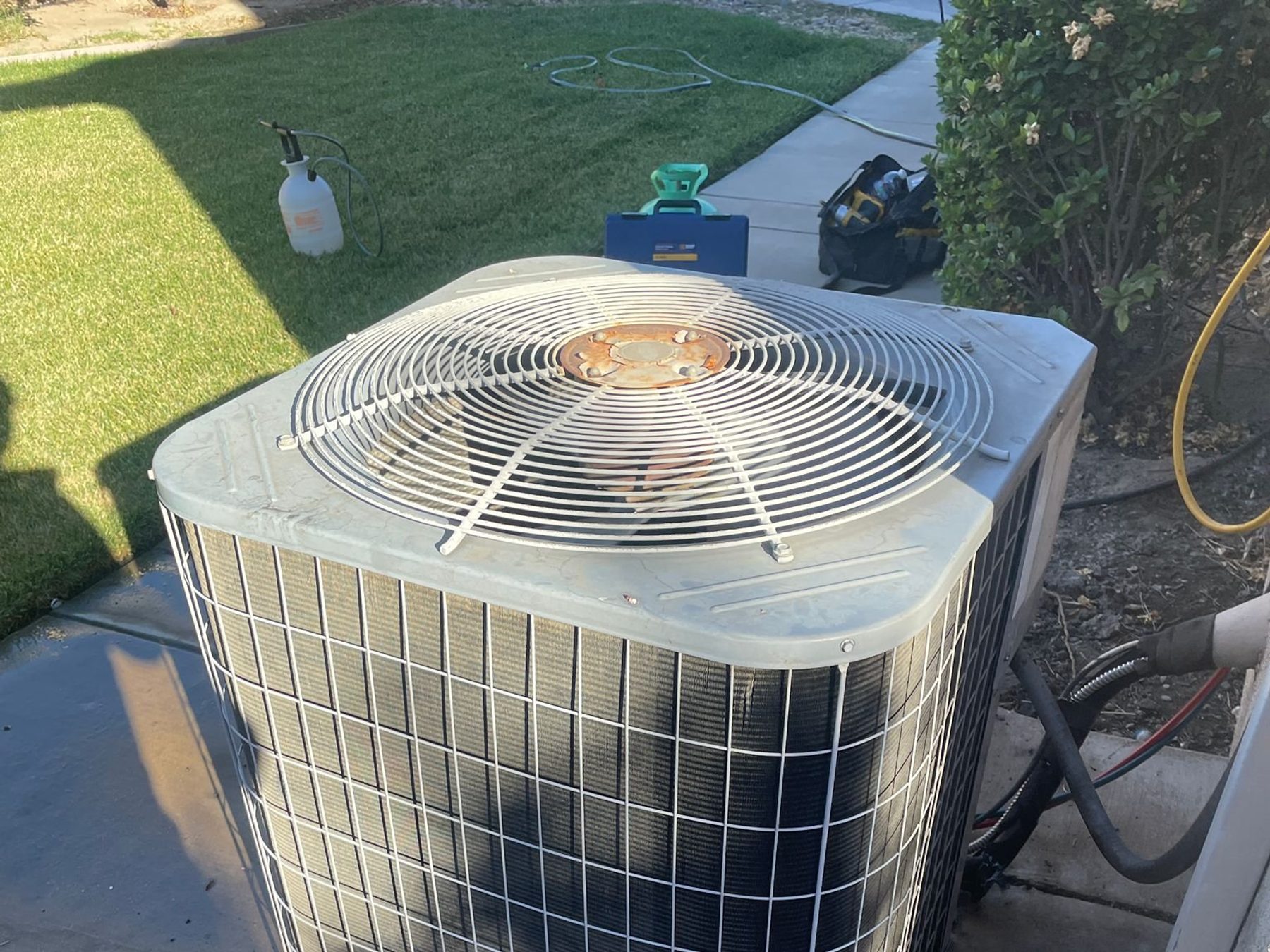
- Check the outdoor unit. Look at the condenser from a safe distance. Is the fan turning? Is the whole coil wet, or only one patch? Is there a shrub or a pile of leaves pressed against it? Keep two feet of clear space around the unit and wash the fins gently with a hose. Also check the small disconnect box on or near the unit, which has a switch in it, and make sure it is in the on position.
Then work through the system in order
The outdoor unit
If the fan is not turning at all, the motor, the capacitor or the disconnect is the problem. If the fan is turning but the air coming off the unit is warm, the system is not moving its heat, and that points to a refrigerant or compressor fault rather than something you can adjust. Rinsing the coil once a year helps, and it is the single most common cause of a system that runs but does not cool well enough.
The indoor blower and the evaporator coil
Open the filter door and look at the coil. If there is a mat of dust on the fins, airflow is restricted and the coil needs a proper clean. A blower that rattles, scrapes or hums without turning is usually a failing motor or a worn belt. A blower that moves air but the system cannot hold temperature is a different problem, and it is usually on the duct side rather than the unit side.
The condensate drain
Water forms on the coil, runs down into the pan and leaves through a small plastic line to the outside. Pour a cup of warm water into the drain opening at the base of the cabinet and watch the outside end of the line. If nothing comes out, the line is blocked. A small blockage at the opening can often be cleared, but a blockage deeper in the line, or a pan that is cracked, is a technician job, because it means taking the cabinet apart.
The furnace
If you have a gas furnace with a standing pilot light, find the pilot and check whether it is lit. Follow the manufacturer instructions to relight it, and never light a furnace with a match you are holding. If the pilot will not stay lit, the thermocouple is usually at fault. Newer furnaces use electronic ignition and there is nothing for you to light. If the furnace will not ignite at all, that is a technician job, and so is any fault involving the heat exchanger.
The thermostat again
If everything above checks out, go back to the thermostat with a different question. Is it reading the room temperature correctly? Is it in the right mode for the weather? Has the schedule been changed by a power cut, which happens more often than people expect? A thermostat that is off by ten degrees will run the system continuously without ever satisfying itself.
Symptom and likely cause
| Symptom | Likely cause | Where to look first |
|---|---|---|
| Nothing happens at all | Tripped breaker, dead thermostat batteries, failed capacitor | Breaker, then thermostat, then the outdoor disconnect |
| Fan runs but no cool air | Dirty filter, dirty coil, low refrigerant | Filter, then coil, then let a technician check the charge |
| System starts and stops quickly | Clogged filter, low refrigerant, oversized system | Filter first, then a technician for sizing and charge |
| Water on the floor or in the cabinet | Blocked condensate drain, cracked coil, leaking line | The drain line outside, then stop and call |
| Ice on the lines in warm weather | Low airflow or a low refrigerant charge | Filter and coil, then call for a charge check |
| One room hot, another cold | Duct leaks, blocked registers, blower fault | Vents and registers, then a duct inspection |
| Burning or hot electrical smell | Electrical fault, failing motor or capacitor | Switch the system off and call |
A breaker that keeps tripping, a burning smell and a line that is oily or stained are not troubleshooting jobs. They are stop jobs.
When to stop and call a licensed technician
You can cover a lot of ground with the checks above, but there is a line, and it is worth knowing where it is. Put the tools down and call a licensed HVAC technician if you hit any of these.
- The breaker trips again as soon as you reset it, or you find scorch marks or heat on a panel.
- You smell burning, hot plastic or a hot electrical smell anywhere near the equipment.
- You see ice on the refrigerant lines while the weather is warm.
- You find a refrigerant line that is oily, stained, corroded or dented. That is a leak, and refrigerant has to be recovered and handled by a certified technician.
- No air is coming from any vent, and the fan is running. The motor has failed.
- Water is coming from the unit itself rather than from the drain line.
- The furnace will not ignite, or the flame is yellow or orange instead of blue.
- You are considering opening a refrigerant line, working inside the electrical panel or dismantling a blower cabinet.
RB HVAC Inc. is a licensed HVAC contractor based in Stockton, licensed in California under number 1094161, serving Stockton, Sacramento, Modesto and surrounding communities. If you have been through the four checks and the system still misbehaves, call (209) 351-6000 and we will tell you what we find, in writing, before any work starts.