It surprises people every winter. The unit is covered in ice, the house is warm, and it looks like something has gone badly wrong. Usually it has not. The heat pump freezes the outdoor coil on purpose, and a defrost cycle melts it away.
Why a heat pump freezes on purpose
A heat pump does not burn fuel. It moves heat, using refrigerant, a compressor, two coils and a fan. In the summer the outdoor coil releases the heat from your house. In the winter the machine reverses, and the outdoor coil becomes an evaporator, collecting heat from the outdoor air.
When the outdoor air drops low enough, the coil ends up colder than the air around it. Any moisture in that air freezes on the fins, and you get a white shell of ice across the coil. That is expected, and it is why the controller kicks off a defrost cycle: the flow reverses for a few minutes, warm refrigerant melts the ice, and the machine goes back to heating.
This is why ice on a heat pump in winter is not a fault by itself. A thin, even layer that builds and then goes away is the machine working. Ice that is thick, ice that stays for hours, or ice that returns faster than the machine can clear it is a fault.
The faults that leave ice on the unit
Six faults cover most of these calls. Each leaves the coil colder than it should be, or stops the machine clearing it.
- Low refrigerant. The coil cannot pull enough heat out of the outdoor air, so it runs colder and keeps freezing
- A failed defrost control. The cycle never finishes, so the ice stays where it is
- A reversing valve stuck in the wrong position. The machine cannot switch between heating and cooling
- A blocked condensate drain. The melting water has nowhere to go, so it refreezes on the unit
- A bad thermistor. The coil sensor reads wrong, so the defrost timing is wrong
- A fan that has stopped. With no air moving over the coil, the refrigerant cannot pick up heat
Five checks you can make in the yard
- Do not use metal on the ice. A pry bar, a screwdriver or a hammer will gouge the coil fins, and bent fins cut the airflow across the coil and make the fault worse. Use a plastic shovel to clear snow, or warm water from a hose.
- Keep the area around the unit clear of snow. Snow banked against the unit blocks the airflow the fan needs, and the coil gets colder for it. Leave the same clear space around the unit that you would leave in summer.
- Watch the ice for an hour. Note the time you first see it and look again later. If it clears and does not come straight back, that was a normal defrost cycle. If it is still there, you have a fault.
- Look at which side is frosting. Ice that builds evenly across the whole coil is normal. Ice on one side or one corner only points at blocked airflow, a fan that has stopped, or a valve that is not switching.
- Check for water and ice at the base of the unit. A pool that refreezes on the pad, or a frozen block around the drain line, is a drain blockage rather than a defrost fault.
Where the technician line starts
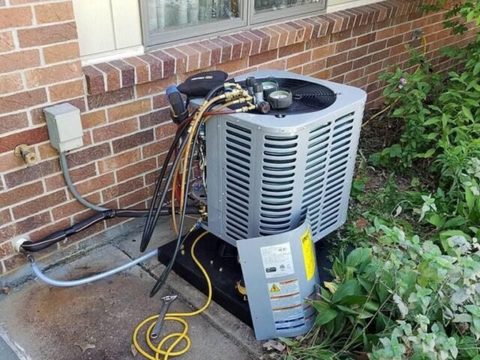
Persistent ice means a refrigerant fault or a control fault, and the only way to tell them apart is to put gauges on the lines and test the controls. A low charge has to be measured, and the leak behind it found. A defrost control, a thermistor and a reversing valve all need a meter. The outdoor unit, which some people still call the condenser unit, has a service panel and a service disconnect beside it, and both are technician work.
Do not open the outdoor unit, do not touch the refrigerant lines, and do not pour hot water on a frozen unit if the electrical disconnect is close by. Call a licensed technician if the ice is still there after an hour, if the unit has stopped running altogether, or if you hear hissing at the lines.
| What you see | What it usually means | Who can fix it |
|---|---|---|
| A thin even layer that melts within an hour | A normal defrost cycle, the machine is working | Nothing to do |
| Ice that stays for hours and keeps building | Defrost control has failed, or the unit cannot switch out of the mode | Technician |
| Thick ice across the whole coil | Low refrigerant, the coil cannot collect enough heat | Technician |
| Ice on one side or one corner only | Stopped fan, blocked airflow, or a valve that is stuck | Technician |
| Ice and water at the base of the unit | Blocked condensate drain, the melt water has nowhere to go | Technician |
| Defrost runs but the house stays cold | Bad thermistor, or a board that is not calling the cycle | Technician |
Ice that comes and goes is a heat pump doing its job. Ice that stays is a machine telling you it needs a technician. The difference is one hour of watching, and after that it is gauges and a meter.
What happens when we come out
We put gauges on the refrigerant lines and read the charge, then we force the unit through a defrost cycle and watch whether the coil actually clears. We check the fan and the capacitor, the defrost control, the thermistor and the reversing valve, and we clear or flush the condensate drain. The fault is written down and the price agreed in writing before any work starts.
The honest version
If you would rather have somebody look at it, our heat pump services page explains how we handle a fault like this, and the symptom hub lists the rest of the symptoms we get called about, one at a time.
Most ice on a heat pump in winter is nothing to worry about. The ones that are a fault show a pattern: ice that returns the same day, ice on one side only, or water and ice at the base of the unit. Those point at the defrost controls, the thermistor or the drain, and the charge gets measured before anyone calls it a refrigerant problem. If your outdoor unit has ice on it, call (209) 351-6000 and tell us whether it cleared and how long it took, and we will tell you honestly whether this was a normal defrost cycle or a fault. RB HVAC Inc. holds California HVAC license number 1094161, and we quote the price in writing before any work starts.