That combination tells you something useful. A compressor that has failed outright usually stops the outdoor unit, and a dead thermostat does the same. When the fan is turning and the machine is humming but the air is warm, the system is running a cooling cycle and the heat is not leaving the house.
What is actually going on
Eight causes cover almost every call we get on this symptom, listed in the order they are worth thinking about, cheapest and most likely first.
- The thermostat is in heat mode, on fan, or set warmer than the room
- The filter is clogged and the coil is starved of air
- The evaporator coil is coated in dust and cannot move heat
- The refrigerant is low because of a leak
- The capacitor or the contactor has failed
- The compressor is failing and cannot pump heat
- The equipment is undersized for the house
- The ductwork is leaking, disconnected or undersized
The two checks that take a minute
These are the two we find most often, and they are the two a homeowner can genuinely fix without a tool. If the system has been running this way for a while, begin with them.
The thermostat is on the wrong setting
A thermostat left on heat in July will hold the house warm and run the cooling system all day without ever asking for cold air. Check the mode indicator first, because a system in the wrong mode is the most common thing we find. Then check the fan setting. A fan that runs constantly but never cools anything is usually set to on rather than auto. Check the set temperature as well. If it is at or above the room reading, the system has no reason to cool. Set it a few degrees lower and give it half an hour.
The filter is clogged
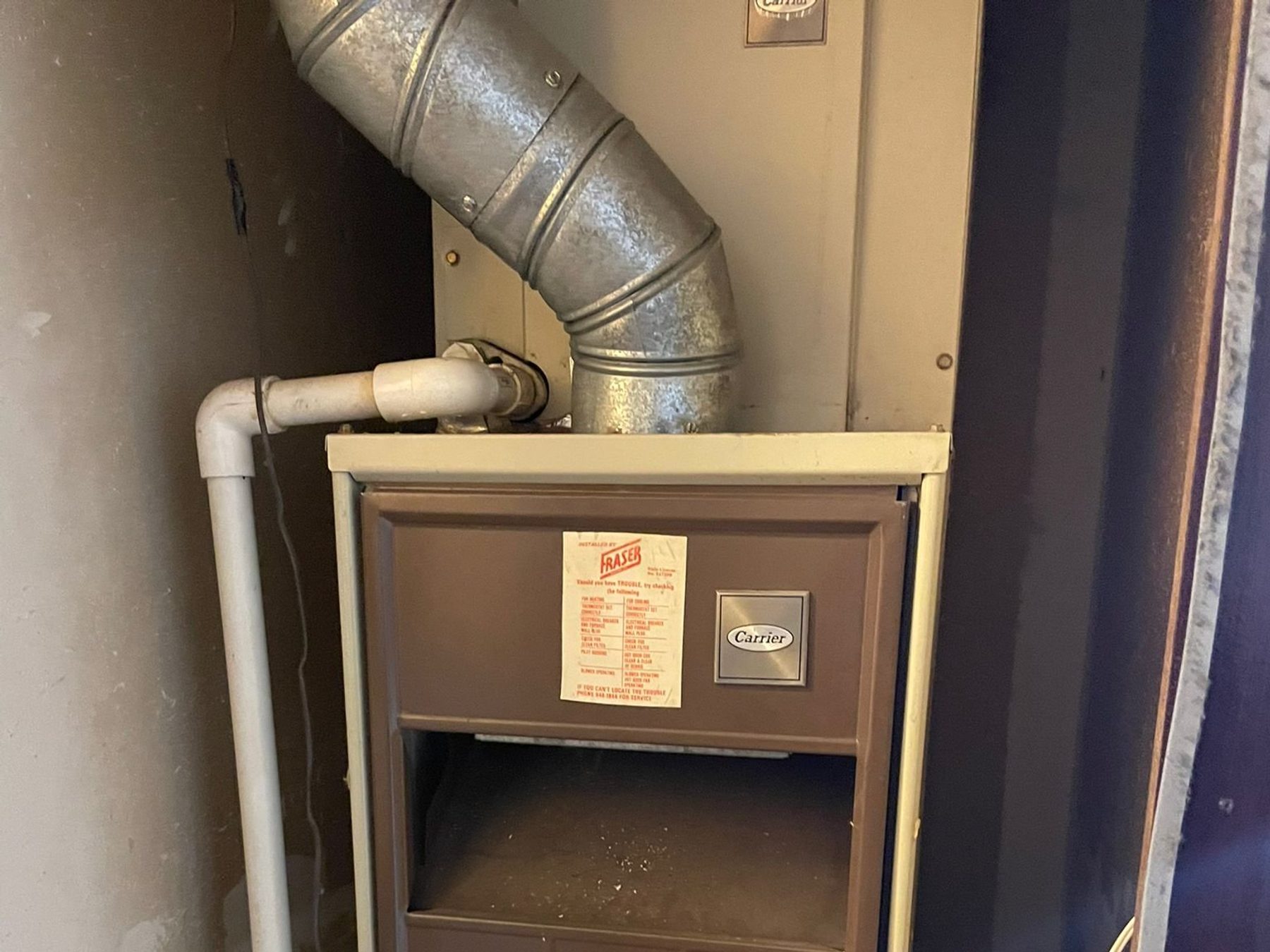
A clogged filter is the most common fault we see and the one most people forget about. When the filter is packed, the blower moves less air, and less air means the coil gets colder and colder until it ices over. A frozen coil blocks the airflow and the system shuts itself down, leaving a warm house and an outdoor unit that cycles on and off. Find the filter. It sits in a slot in the indoor unit or the furnace cabinet, or in the return duct near the wall. If it is grey, matted or bent, that is your answer.
Five more checks you can safely do
- Look at the outdoor unit from a distance. Is the fan turning? Is the unit buried in weeds, or has a mat of leaves pulled against the coil? A blocked outdoor unit cannot shed heat. Clear the vegetation and debris, leave a foot or two of space around it, and give it time to recover.
- Check the air at the supply vents. Air coming out of the vents should feel noticeably cooler than the room it is in. If the air at the register is the same temperature as the rest of the house, the fault is on the cooling side, not in the ductwork.
- Look for a closed vent. If one room is warm and the rest of the house is fine, a register in that room may have been closed for the season or knocked shut. A closed vent sends the air somewhere else and starves the room you wanted cool.
- Check the indoor unit for an open door or a loose panel. On a furnace with the blower inside the cabinet, an open door can stop the blower or put the system into a safety shutdown. Close it fully and make sure the filter slot is seated properly.
- Check that a filter is in place. If it has been left out of the slot, or fitted on the side instead of in the rack, the system has been running on no filter at all. That is how an evaporator coil ends up filthy in one season.
Where the line sits
There are two things on this list you should not attempt, however handy you are. Do not open the refrigerant lines, and do not open the electrical panel beyond switching a breaker back on. The service disconnect beside the outdoor unit, which some people still call the condenser unit, is technician work. If you suspect a refrigerant leak, or if the compressor is running and the house is still warm, that is where the job belongs to a licensed technician.
| Cause | How it shows up | Who can fix it |
|---|---|---|
| Thermostat on heat or set wrong | Runs constantly, house stays warm, the fan may never start | You, in a minute |
| Clogged filter | Weak air, ice on the coil, short cycling, water near the indoor unit | You, in a minute |
| Dirty evaporator coil | Warm air at the vents and a blower that sounds strained | Technician |
| Low refrigerant from a leak | Runs constantly and never cools, ice on the outdoor line in summer | Technician |
| Failed capacitor or contactor | The unit hums but the fan will not turn | Technician |
| Failing compressor | The unit runs but nothing is pumped, with a loud noise | Technician |
| Undersized equipment | Runs for hours and never catches up, one room always warm | Technician, and a sizing question |
| Leaking or disconnected ductwork | Cool air at the unit and nowhere else, some rooms never cool | Technician |
A system that runs and does not cool is rarely a small fault. In our experience it is nearly always refrigerant, coil, airflow or sizing, and only two of those are things you can put right yourself.
What happens when we come out
We start at the thermostat, because everything downstream depends on what the thermostat is asking for. Then we read the pressures on the gauges and the temperatures across the lines, which tells us whether the charge is right, whether the compressor is pumping and whether the coils are clean. We check the capacitor, the contactor, the blower and the filter slot, and the airflow at the outdoor unit. If the air leaving the indoor unit is warm, we trace the ductwork. You get the fault written down and the price in writing before anything is taken apart.
If you would rather have somebody look at it, our HVAC repair page explains how we handle a fault like this, and the symptom hub lists the rest of the symptoms we get called about, one at a time.
If your system is running and the house is not cooling, call (209) 351-6000 and tell us which rooms are warm and what the outdoor unit is doing. We will tell you honestly whether it is a filter and a thermostat, or a job for a technician. RB HVAC Inc. holds California HVAC license number 1094161, and we quote the price in writing before any work starts.