There is a difference between a furnace that will not start and one that starts and then stops again. Nothing at all points at the thermostat, the power or the safety switches. A furnace that fires and gives up within a minute is running its own safety system.
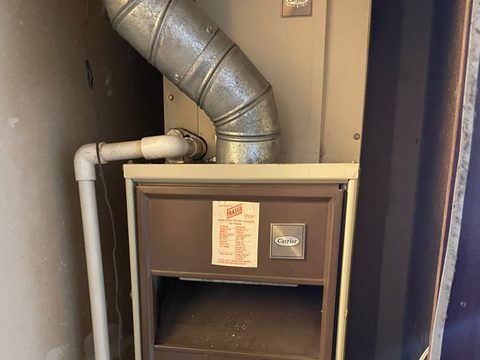
What actually stops a furnace from starting
Nine things account for nearly every call on a furnace that does nothing.
- The thermostat is on cool, or the schedule has heat switched off
- The thermostat screen is blank because the batteries are flat
- The circuit breaker for the furnace has tripped
- The furnace switch on the wall is off, or the blower motor has failed
- A unit with a door switch will not run while the cabinet door is open
- A blown fuse on the control board
- A failed control board
- A failed inducer motor or a dirty flame sensor on a gas furnace
- A gas supply problem, or a gas valve that will not open
Five checks before you call anyone
- Set the thermostat to heat and turn the fan to auto. Then set the temperature a few degrees above the room reading. If the thermostat is on cool, the furnace is never asked for heat. A programmable thermostat can also be on a heat setting for hours nobody is home for, so check the schedule.
- Replace the batteries if the screen is blank or the unit will not respond. A flat battery stops a thermostat dead and the house goes cold. Take the batteries out, leave them a minute, then fit new ones. If the screen lights up, the battery was the fault.
- Look at the breaker for the furnace. If it has tripped, switch it fully off, wait a moment, then switch it back on once. If it trips again, leave it off and call. A breaker that keeps tripping needs a meter, not another reset.
- Find the furnace switch on the wall. Most furnaces have a light switch next to the furnace that powers the whole unit. It is off more often than anyone expects, usually after a clean out or a power cut. Turn it on and listen for the blower.
- Check the filter and the cabinet door. A filter left in too long makes a furnace shut down on its high limit switch. On a unit with a door interlock switch, the furnace will not run while the cabinet door is open, so close the door and try again.
Where the line sits, and what to do if you smell gas
This is where the homeowner line sits. Every check so far is one you can make with your eyes and a light switch. Past it is technician work: the gas appliance, the gas valve, the inducer motor, the flame sensor, the control board and the wiring inside it. Do not open the burner compartment, do not take the cover off the furnace, and do not open the electrical panel beyond a breaker reset.
Two rules are absolute. If you smell gas, you leave the house. Do not look for the leak, do not flip a switch and do not make a phone call from inside. Get everyone out, go outside, and call the gas emergency line from there. If a carbon monoxide alarm sounds, you leave the house with everyone in it and call from outside. Do not go back in and do not wait for it to stop.
If the furnace fires and then shuts off
A gas furnace that lights, runs for a few seconds and then stops is usually the limit switch doing its job. The limit switch watches the temperature at the heat exchanger and shuts the burners down when the air gets too hot. A limit trip is not a broken switch. It is a message that the heat exchanger is dirty and the airflow cannot carry the heat away.
That is why a dirty heat exchanger matters so much. It cuts the airflow, it trips the limit, and the furnace does the same thing every time it starts. A cracked heat exchanger is a different matter entirely. That is a carbon monoxide safety issue, not a repair, and the answer is not a new switch or another reset. It is a safety conversation, and we will have it honestly, including when the answer is that the unit needs replacing.
| Fault | What you notice | Where the fix sits |
|---|---|---|
| Thermostat on cool, or a schedule switched off | The thermostat asks for cooling in winter, or nothing at the set time | You |
| Flat thermostat batteries | Blank screen, no response to the buttons | You |
| Tripped breaker | Nothing at all happens when the thermostat calls for heat | You, once only |
| Furnace switch off, or a failed blower motor | The unit is dead, or the blower never starts | The switch is yours, the motor is not |
| Door interlock switch | Nothing happens with the door open, it starts when you close it | Technician |
| Blown fuse on the control board | The furnace has power but does nothing at all | Technician |
| Failed control board | No call for heat reaches the furnace, or it runs with no demand | Technician |
| Failed inducer motor or a dirty flame sensor | The furnace tries to start, clicks, and shuts down again | Technician |
| Gas supply problem or a gas valve that will not open | No ignition at all, or the burner will not light | Technician |
A furnace that does nothing is usually a control fault rather than a heating fault. A furnace that fires and stops is usually the safety system telling you the heat exchanger is dirty. Neither is one to push through on your own.
What happens when we come out
We check the thermostat and the power first, then the safety switches and the gas side. On a gas furnace we test the inducer, the flame sensor and the gas valve, and we pull the filter and look at the heat exchanger. If the limit switch has been tripping, we find out why instead of resetting it. On an electric furnace we test the blower motor, the capacitor and the control board. You get the fault written down and the price in writing before any work starts.
If you would rather have somebody look at it, our HVAC repair page explains how we handle a fault like this, and the symptom hub lists the rest of the symptoms we get called about, one at a time.
If your furnace does nothing when the thermostat calls for heat, call (209) 351-6000 and tell us whether it runs on gas or electricity, where the unit sits, and whether there is any noise or smell. That short description tells us a long way before we arrive. RB HVAC Inc. holds California HVAC license number 1094161, and we quote the price in writing before any work starts.